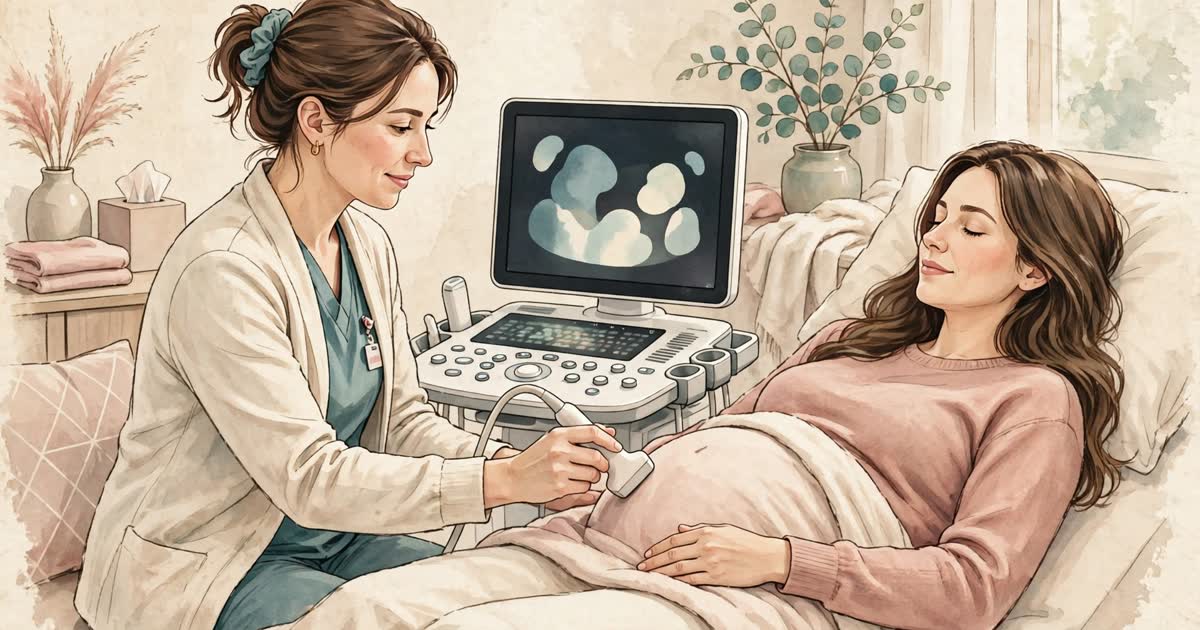
The most useful maternity-safety development this week is not another celebrity birth. On 22 September 2026 the UK announced a national investigation into placenta accreta spectrum (PAS) — a condition where the placenta grows too deeply into the uterine wall and can cause catastrophic bleeding at birth.
Background
PAS used to be rare. It is no longer treated as a one-in-a-thousand curiosity. Campaign group Action for Accreta, built by more than 100 families, says 61% of women with PAS were undiagnosed before delivery, 64% needed major emergency surgery, and 30% had an emergency hysterectomy. NHS estimates still range widely — about one in 300 to one in 2,000 pregnancies — because there is no single national dataset that counts cases.
The risk rises with prior uterine surgery, especially caesarean birth. That matters because C-section rates have climbed. RCOG updated its Green-top guidance in June 2026 to stress that PAS is not only a “praevia plus previous C-section” problem. Other uterine trauma (curettage, hysteroscopy, myomectomy, endometrial ablation, uterine-artery embolisation) also belongs on the risk list. A new section covers caesarean-scar ectopic pregnancy as a precursor.
What changed this week
The Health Services Safety Investigation Body (HSSIB) will look at two practical questions:
- How well PAS is diagnosed during pregnancy.
- How women are referred into specialist centres.
HSSIB can compel people to answer. Action for Accreta called the decision “a landmark for maternal safety in the NHS.” Erin Cooper, who needed 13 transfusions after an emergency C-section in 2024 and later left nursing, said the inquiry will not rewrite her story — but it might stop the next one.
Amisha Adhia, who founded the campaign after nearly dying with her daughter, said five hospitals told her there was nothing to worry about. “The only reason we are here is that one consultant refused to accept that accreta could be ruled out.”
Competing viewpoints
Campaigners want mandatory PAS training for sonographers and midwives now, not after a multi-year report. They also want a national register so units cannot miss a rising caseload.
Specialist centres and RCOG already have pathways: identify risk at the first antenatal visit and at the 18–20 week scan, then send high-risk women to a centre that can plan delivery with blood products, interventional radiology, and a surgical team. The argument is not whether those centres work. It is that too many families never get there.
NHS voices have previously said PAS is “likely” rising with the C-section rate and that the specialised-service specification is under review. That is not the same as a counting system or mandated training in every unit.
Researchers at UCLA (AJOG) have also shifted the scientific story this year: the problem may start in how a uterine scar heals — disordered collagen and lingering inflammation — rather than a placenta that “invades” on its own. That does not change tonight’s birth plan. It does change how future prevention research is framed.
What parents should do now
- If you have had a C-section or other uterine surgery, say so at the first antenatal appointment. Ask whether the 20-week scan will specifically look at placental location and scar attachment.
- Bleeding in later pregnancy is not “wait and see” by default. Ask whether PAS has been considered, and whether you should be seen at a specialist centre rather than a general unit.
- If PAS is suspected, ask who will be in the room at delivery, where blood products sit, and whether hysterectomy is on the contingency list. Planned PAS births look different from unplanned ones.
- Do not treat social-media birth stories as a substitute for local protocol. Outcomes track preparation, not luck.
What to watch next
- The HSSIB scope and first public updates.
- Whether NHS England actually funds a national PAS dataset.
- Whether mandatory sonographer/midwife training arrives before the report, as campaigners asked.
- How units handle the rising C-section denominator — the risk pool is larger even if individual risk stays modest.
This is not a reason to fear every planned C-section. It is a reason to treat placental attachment as a question that belongs on the scan list, not a surprise in theatre.
Sources: BBC (22 Sep 2026), RCOG Green-top update (30 Jun 2026), Action for Accreta campaign figures, UCLA/AJOG scar-healing research coverage.
Comments (0)
No comments yet.
Sign in to comment.