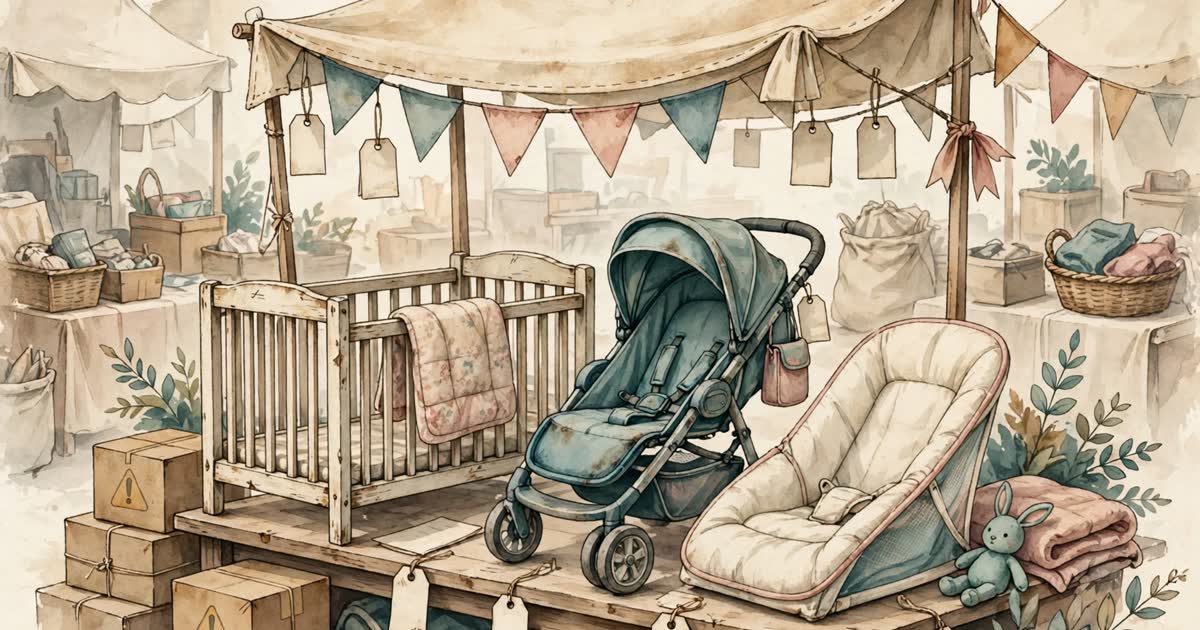
The most useful product-safety story this week is not a new stroller launch. On 23 September 2026 Consumer Reports published an evaluation of four large secondhand marketplaces — Craigslist, eBay, Facebook Marketplace, and Mercari — and found listings for baby products that U.S. federal rules already treat as banned or effectively off the market.
This is not legal advice and it is not a shopping guide. It is a map of what changed, why resale platforms keep failing this test, and what a parent can do before clicking “Buy.”
Background
For more than a decade, U.S. regulators have pulled a short list of infant products out of legitimate retail because the design itself is the hazard:
- Drop-side cribs, linked to infant entrapment and deaths.
- Padded crib bumpers, linked to suffocation and strangulation.
- Infant inclined sleepers, pulled after a cluster of deaths and a federal ban on inclined sleep products.
- Infant in-bed sleepers marketed for co-sleeping, which conflict with the AAP’s firm, flat, separate-surface sleep guidance.
Those rules work at big-box checkout. They do not automatically work on a phone listing written by a stranger. Secondhand markets are where a recalled sleeper, an expired car seat, or a drop-side crib still finds a buyer who thinks “used” means “cheaper and fine.”
Car seats sit in a related gray zone. They are not banned as a class, but a used seat can hide a crash history, missing parts, or an expired shell. Consumer Reports testers found that Facebook Marketplace, Craigslist, and Mercari offered no extra safety prompt when someone tried to list a used car seat. eBay forced a “new” condition choice after a photo upload, which does not stop the free-text description from saying the seat is used.
What changed this week
CR’s evaluators looked for the banned sleep and crib products above. They found them on every platform in the study. After counting 50 infant in-bed sleepers in the first 65 Facebook Marketplace listings they reviewed, they stopped counting.
All four platforms received CR’s lowest rating for catching unsafe or banned baby products before a listing goes live. Corporate policy pages can look strict. The listing flow still lets the item through.
That is the development parents can use: the gap is not “is this product illegal in a store?” It is “will the app stop me from buying a banned sleeper tonight?”
Competing viewpoints
Platforms argue they already prohibit recalled and banned goods, rely on keyword filters, and remove listings after reports. That is true as a policy statement and incomplete as a safety system. Keyword filters miss misspellings, photos without the banned phrase, and “vintage crib” euphemisms.
Sellers often list in good faith. A grandparent clearing an attic does not open CPSC.gov first. That does not make the crib safe.
Parents hunting bargains are not reckless. New cribs, mattresses, and car seats are expensive. The tension is real: household budgets versus products whose failure mode is a silent sleep death. Public-health groups have been blunt for years — buy sleep surfaces and car seats new when you can, and treat secondhand sleep gear as a last resort you verify against recalls.
Consumer advocates say the platforms should block the listing at upload, the way payment networks already block some illegal goods. Marketplaces reply that they are not retailers and cannot inspect every photo. CR’s finding this week is that the current balance still puts the inspection job on the parent.
What parents can use now
- Before you buy any used crib, sleeper, bumper, or infant lounger, search the exact product name plus “recall” on CPSC.gov and SaferProducts.gov.
- Do not buy drop-side cribs, crib bumpers, inclined sleepers, or in-bed sleepers — even if the listing says “never used” or “just for naps.”
- Treat used car seats as high-risk unless you know the full history: no crash, not expired, all parts present, no unknown reseller.
- Cribs, crib mattresses, and breast pumps are in the same “prefer new” bucket for hygiene and hidden-damage reasons.
- If you are the seller, take the extra minute. A listing that should not exist is how banned gear stays in circulation.
What to watch next
Whether any of the four platforms add hard blocks for the banned product names CR used as test cases. Whether CPSC follows the evaluation with a public warning or a platform-specific demand. Whether Child Passenger Safety Week traffic (20–26 September 2026) produces a measurable drop in used-seat listings — or just more of them.
Sources: Consumer Reports evaluation and press release, 23 September 2026; CPSC recall database; AAP safe-sleep guidance.
Comments (0)
No comments yet.
Sign in to comment.